Why are edible trees increasingly included in specifications?
In recent years, food forests and pick-your-own gardens have significantly increased in the Netherlands. What started as small-scale initiatives by individuals and foundations is now also seen in municipalities. Utrecht, Nijmegen, and Almere have incorporated food forests into their green policies. On estates, traditional orchards are being restored or expanded with unusual varieties. And in new housing developments, pick-your-own gardens are increasingly appearing where residents can harvest fruit and nuts. Many of these trees also bloom abundantly, making them valuable for pollinators. Nut trees like walnut and Turkish hazel are also strong, drought-tolerant trees that can withstand the changing climate well. This makes them interesting for projects where you want more than just ornamental trees. In this article, we describe some unusual fruit and nut trees that are worth knowing.
Which unusual fruit trees are hardy in our climate?
Asimina triloba (Pawpaw)
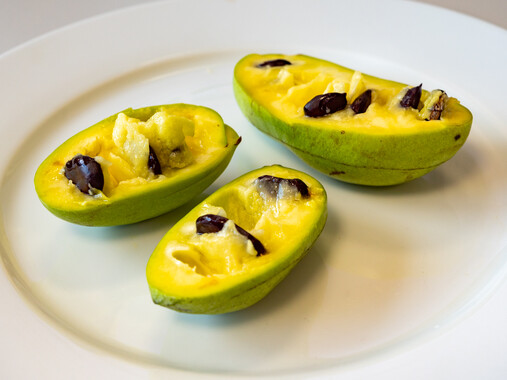
The pawpaw might be the most surprising fruit tree for our climate. Large leaves that look tropical, dark red flowers in spring, and fruits with a taste reminiscent of banana and mango.
Despite its appearance, Asimina triloba is fully hardy to -25 degrees. The species originates from the eastern United States, where the climate is similar to ours. An important point: for reliable fruiting, plant at least two trees close together so they can pollinate each other.
Height: 5-8 metres. Suitable for food forests, unusual gardens, and sheltered spots with enough space.
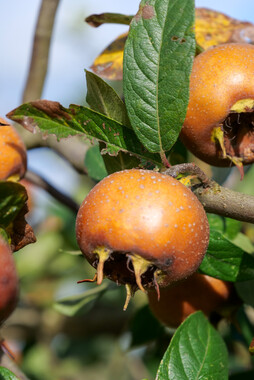
Mespilus germanica (Medlar)
The medlar is a tree with a long history. For centuries, it was a staple in European gardens and orchards, but in recent decades the species has somewhat fallen out of favour. That's a shame, as it is one of the most unusual fruit trees you can plant. The tree grows in a gnarled manner, has beautiful leaves with autumn colouring, and bears fruits that soften after the first frost. This ripening process is called 'bletting'. Once soft, the fruits taste like a mix of apple pie and applesauce.
Cultivars: 'Westerveld' (reliable fruit quality) and 'Bredase Reus' (larger fruits, high yield).
Height: 4-6 metres. The gnarled growth habit also makes the medlar worthwhile as an ornamental tree, especially in historic gardens, on estates, and in pick-your-own gardens.
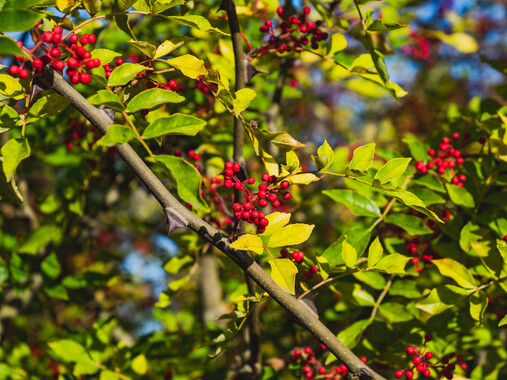
Zanthoxylum simulans (Szechuan pepper)
A species most people wouldn't expect at a nursery. The dried fruit husks of Zanthoxylum simulans are the spice known from Asian cuisine, with that characteristic tingling taste. The tree itself is a small tree or large shrub with fine leaves and fruits that turn red in autumn. The Szechuan pepper requires a sheltered, sunny location and well-drained soil. In edible gardens and educational projects or pick-your-own gardens, the tree always provides a talking point.
Height: 3-5 metres. Suitable for gardens, patios, and small-scale edible plantings.
Cydonia oblonga (Quince)
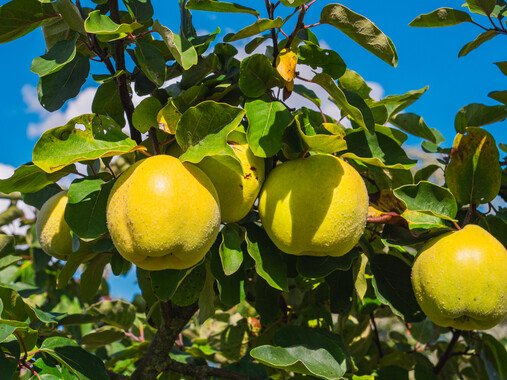
The quince is an underrated tree. In spring, large, white-pink flowers. In autumn, heavy, golden-yellow fruits with a strong fragrance. In winter, a beautiful, open branch structure. It's a tree that looks different throughout the year. The fruits are not to be eaten raw, but after cooking, they develop a deep aromatic flavour found nowhere else. Quince jelly, compote, or used in game dishes.
Cultivars: 'Vranja' (pear-shaped, reliable production) and 'Leskovacka' (apple-shaped, also reliable).
Height: 4-6 metres. Available as standard and multi-stemmed. Suitable for gardens, orchards, and pick-your-own gardens. Not demanding regarding soil, but performs best in a sunny location.
Diospyros virginiana (American persimmon)
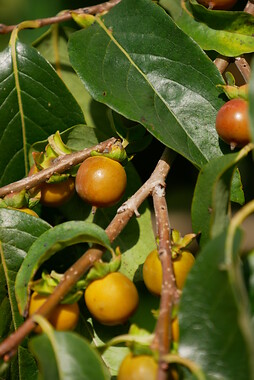
Most people know the kaki from the supermarket. That is the Asian variant, Diospyros kaki. But there is also an American species: Diospyros virginiana. It is hardier than the Asian kaki and therefore more reliable in Northwest Europe.
The fruits are sweet and aromatic, provided they ripen fully on the tree. Additionally, it is a beautiful tree to look at: striking autumn colours in yellow and orange, and a blocky bark structure that is clearly visible in winter.
Height: 8-12 metres. Suitable for food forests and larger gardens where there is space for a medium-sized tree.
Which nut trees are suitable?
Nut trees are often large trees that play a very different role in a project than fruit trees. They grow old, provide shade, and also yield a harvest. In food forests, nut trees often form the upper layer: the canopy under which the rest of the planting grows.
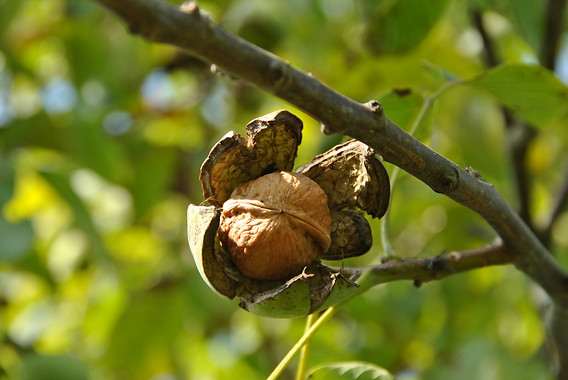
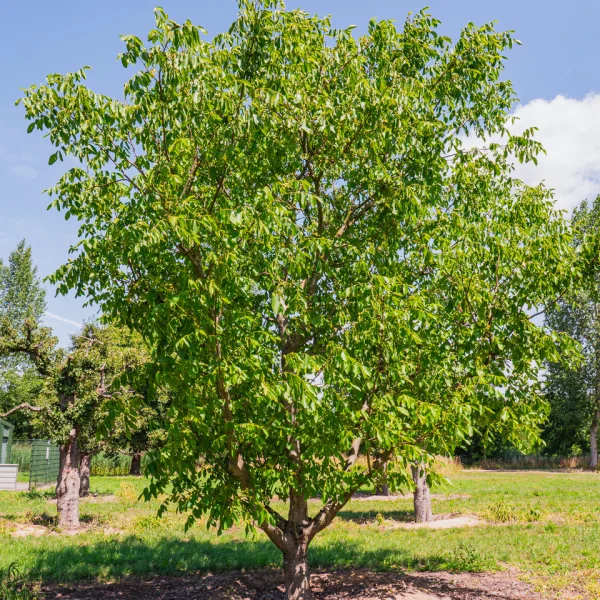
Juglans regia (Walnut)
The walnut is the best-known nut tree, and not without reason. A broad crown, aromatic leaves that provide dense shade in summer, and of course the walnuts themselves. It is a tree that needs space, but gives a lot in return.
Cultivars: 'Franquette' (buds late, making flowering less frost-sensitive; very suitable for our climate), 'Lara' (more compact growth, early and rich fruiting; interesting for smaller gardens) and 'Lange van Lod' (traditional variety with large, elongated nuts and good flavour).
Height: 12-20 metres. Suitable for private gardens with enough space, on estates, in parks, and as the upper layer in food forests.
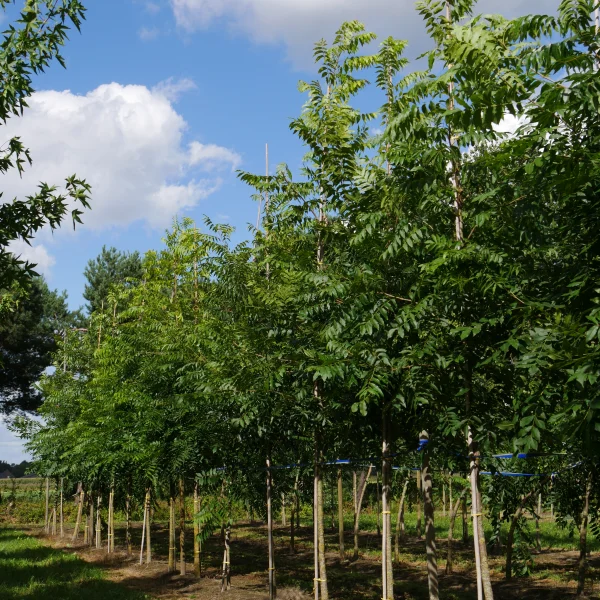
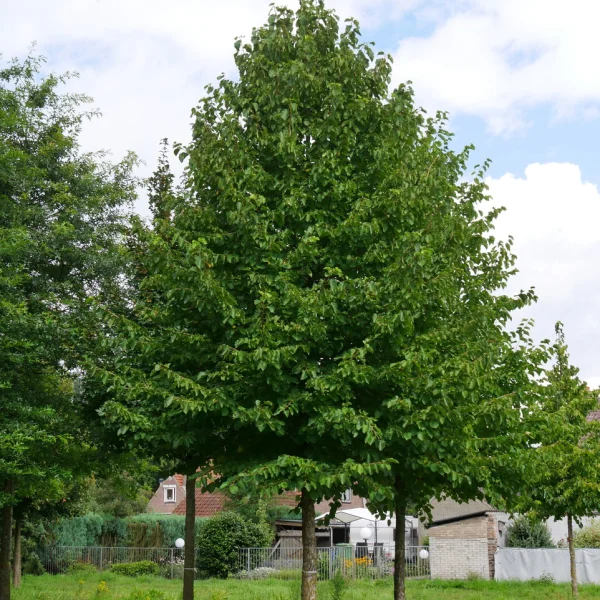
Corylus colurna (Turkish hazel)
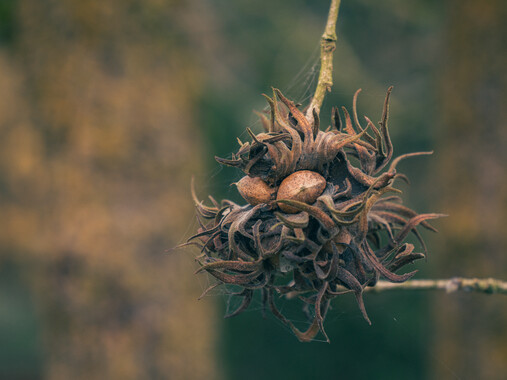
The common hazel is a shrub, but Corylus colurna grows as a full-fledged tree with a straight trunk and regular, pyramidal crown. The cork-like bark is a striking feature all year round. The edible hazelnuts appear in September. What makes the Turkish hazel extra interesting: it is a strong, drought-tolerant tree that performs well in urban conditions. This makes it one of the few nut trees you can also use as an avenue tree or in paved environments.
Height: 12-18 metres. Suitable for avenues, parks, squares, and urban projects.
Carya illinoinensis (Pecan)
The pecan is a tree for large projects. An open, airy crown with compound leaves that turn warm yellow in autumn. Fruiting is possible at a later age in Northwest Europe, but even without nuts, this is a beautiful park and landscape tree due to its size and crown shape.
Height: 15-25 metres. Suitable for estates, large gardens, and food forests where space is not a limitation.
What should you consider when using edible trees in projects?
Pollination
Some fruit trees, like the pawpaw, need a second tree for fruiting. Always check this before specifying a single tree.
Location and microclimate
Species like Cydonia, Zanthoxylum, and Diospyros benefit from a warm, sheltered location.
In a city garden or against a south wall, they perform better than in an open, windy area.
For nut trees, space is especially important: walnut and pecan need a large crown.
Fruits in public spaces
If you plant edible trees in public green spaces, consider maintenance: fruits that are not picked fall to the ground.
Choose species whose fruits are small or harvested late, or plant them in places where this does not cause inconvenience.
Nuts are easier in this regard than soft fruits.
Edible trees in food forests
In a food forest, you work with multiple layers. Nut trees like walnut and pecan form the upper layer. Fruit trees like medlar, quince, and pawpaw fit in the middle layer. Below that, you can work with berry bushes, herbs, and ground covers.
This layering makes a food forest productive and ecologically valuable at the same time.
Conclusion
Unusual fruit and nut trees offer possibilities that go beyond the standard apple or pear. They are hardy in our climate, look good as trees, and fit the growing demand for food forests, pick-your-own gardens, and edible public green spaces.
The species in this article show that the range is broader than many people think. Want to know which edible trees suit your project? Contact our advisors for advice on location, sizing, and availability.

 English
 English (United Kingdom)
 Nederlands
 Nederlands (België)
 Deutsch
 français
 čeština
 polski
 español
 română
 dansk
dansk
 svenska
 magyar
 Türkçe
 slovenčina
 русский
 norsk
norsk